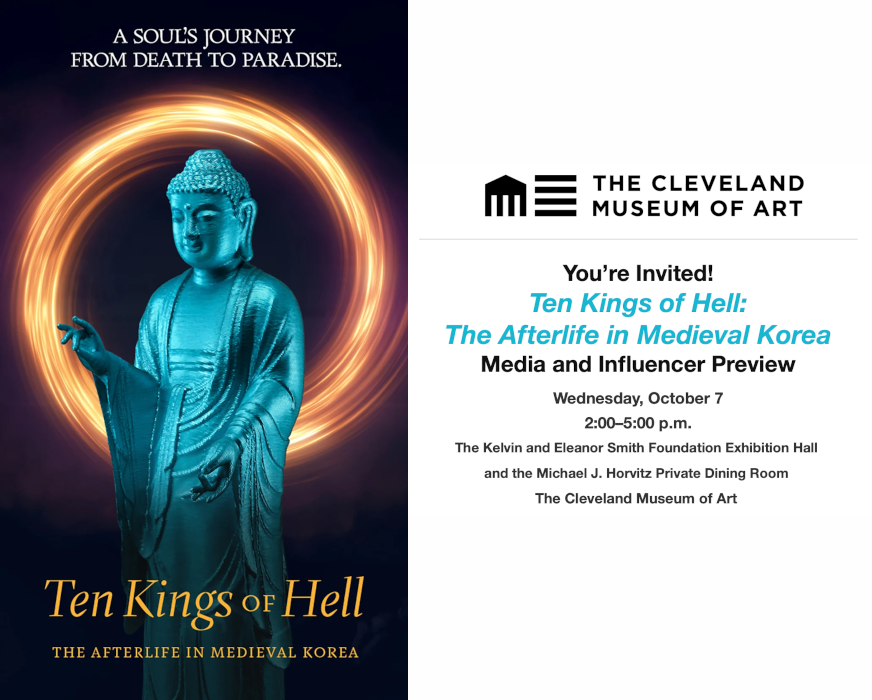
What happens after we die? You’re invited to be one of the first to explore the soul’s journey from death to paradise at the influencer and media preview for Ten Kings of Hell: The Afterlife in Medieval Korea.
Organized in partnership with the National Museum of Korea, this landmark international exhibition, Ten Kings of Hell: The Afterlife in Medieval Korea, explores the artistic legacy of the Goryeo dynasty (918–1392), posing daring questions: How did medieval Koreans envision the world beyond death and how did works of art and materiality shape and reflect that imagined realm?
Presenting an exceptional array of important artworks including recent CMA acquisitions and contemporary works, this exhibition features the historic reunification of a dispersed set of ten hanging scrolls from the 1300s depicting the Ten Kings of Hell. Brought together for the first time since the 1960s, the scrolls offer a rare opportunity to experience the set’s panoramic sequence of judgment, atonement, and salvation.
Just announced: We are delighted to welcome local soprano Ms. Minkyeong Kim, who opens the preview with a special vocal performance of classical Korean arrangements and “Golden” from the critically acclaimed KPop Demon Hunters.
Ms. Minkyeong Kim is a soprano based in Cleveland, Ohio, originally from South Korea. She earned her professional studies diploma in voice from the Cleveland Institute of Music and is an active recitalist and guest artist in the Northeast Ohio area. Her performances include solo recitals and cultural programs, featuring Korean and classical vocal repertoire. Through her performances, she is passionate about connecting audiences with music and celebrating the richness of Korean culture and the arts.
. . .
2:00–5:00 p.m.: Refreshments are served in the private dining room, located next to Provenance Restaurant.
2:00–5:00 p.m.: View 10 Kings of Hell: The Afterlife in Medieval Korea in the Kelvin and Eleanor Smith Foundation Exhibition Hall.
3:30 p.m.: Listen to remarks from Cleveland Museum of Art leadership and exhibition curator, Sooa McCormick, Korea Foundation Curator of Korean Art, in the Kelvin and Eleanor Smith Foundation Exhibition Hall.
3:45 p.m.: Enjoy a vocal performance by Ms. Minkyeong Kim in the Kelvin and Eleanor Smith Foundation Exhibition Hall.
4:00 p.m.: Enjoy a guided tour of the exhibition by Sooa McCormick, Korea Foundation Curator of Korean Art, in the Kelvin and Eleanor Smith Foundation Exhibition Hall followed by brief Q and A.
. . .
Ten Kings of Hell: The Afterlife in Medieval Korea is organized by the Cleveland Museum of Art in partnership with the National Museum of Korea. This exhibition is made possible by this special relationship and a generous multiyear grant awarded through the museum’s Overseas Korean Galleries Support Program.
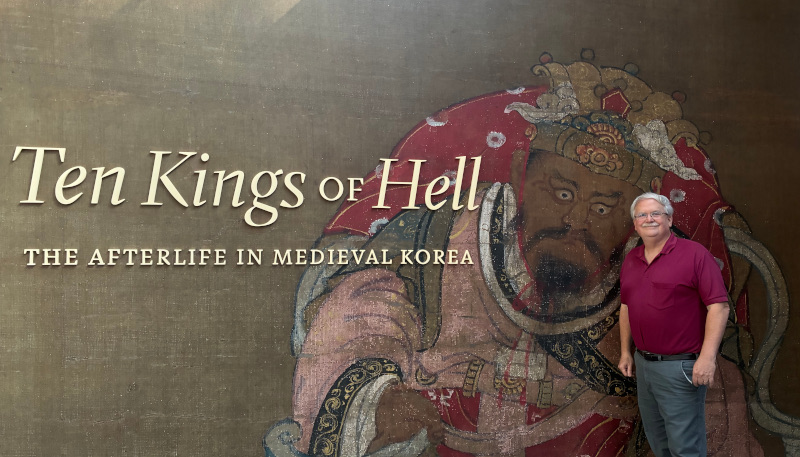
I have to say this is the first time that I have received an invitation to go to hell. On Wednesday, October 7, 2026, I joined others that were invited for a preview of the Cleveland Museum of Art's newly opened exhibition, Ten Kings of Hell: The Afterlife in Medieval Korea I put this blog post together to share what I learned during the preview and to encourage others to visit this exhibition before it closes on Sunday, January 3, 2027.
Interesting People I Met
I would like to start by mentioning some of the people I met during this event.
Before the preview, I talked to some people from the University Circle marketing staff while enjoying some refreshments in the museum's private dining room. It was good to learn about their good work. I told them how my wife and co-blogger, Julie, and I are often write about events and museums in University Circle. (In addition to the Cleveland Museum of Art, we've written about: Cleveland History Center, Cleveland Museum of Natural History, Cleveland Botanical Garden.) Click here to read some of our 88 blog posts about University Circle. While writing this blog post, I found it interesting to see the Thursday, October 15, 2026, announcement of a name and branding change for Cleveland's cultural circle:
While I was talking to the University Circle marketing staff, artist Carla Wagner joined us. "Carla Wagner is a recent Spring 2025 graduate from Kent State University. She pursued a B.F.A. in Studio Art with a concentration in Painting and a Minor in Drawing." She is currently working at University Circle, and she told me about her upcoming show at Summit ArtSpace: Bad Girls | Group Exhibition (October 15 - December 19, 2026). I always enjoy the art shows in Akron at Summit ArtSpace (click here to see my related blog posts). I hope to see the current exhibitions.
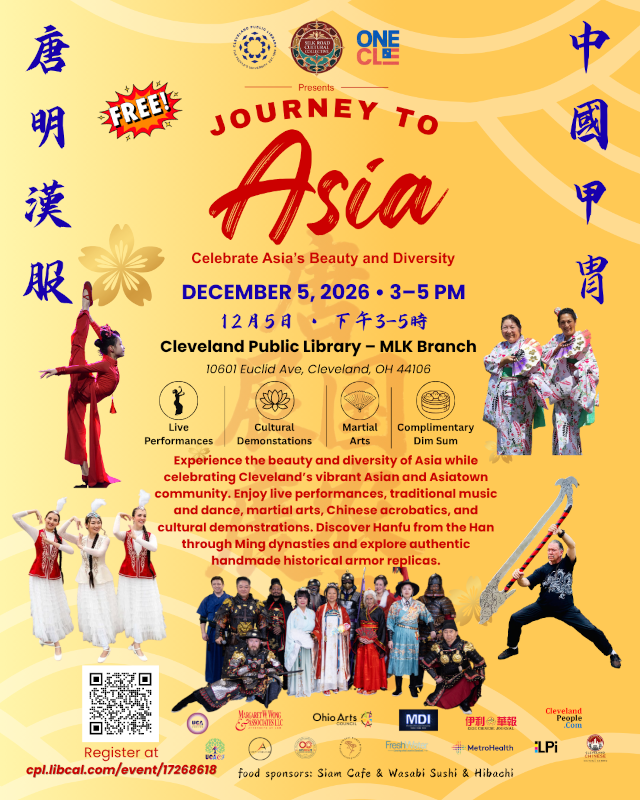
Finally, I want to thank Dan Hanson (be sure to see his website: ClevelandPeople.com) for introducing me to Johnny Wu, who I often see on social media taking a leadership role in Cleveland area cultural events. They told me about the Silk Road Cultural Collective’s upcoming Saturday, December 5, 2026, Journey to Asia, which I would like to attend.
Going to Ten Kings of Hell
After leaving the museum's private dining room, I went to the Museum's special exhibitions galleries to explore Ten Kings of Hell: The Afterlife in Medieval Korea on my own. I want to thank the Cleveland Museum of Art for giving me a special commemorative pin from the exhibition as I entered the gallery.
Before attending the preview, I assumed that the artwork shown in the exhibition would be from only the Goryeo dynasty, which the announcement from the museum listed as existing from 918 to 1392. According to Encyclopædia Britannica, "Goryeo dynasty, in Korean history, dynasty that ruled the Korean peninsula as the Goryeo kingdom from 935 to 1392 CE. During this period the country began to form its own cultural tradition distinct from the rest of East Asia. It is from the name Goryeo that the Western name Korea is derived." As I entered the galleries to see the the optical fibers of Anicka Yi's Bending Willow Branches (2025), I quickly realized that I was wrong. While most of the items are from medieval Korea, there are also several contemporary pieces, including:
A film (Autoradiography, Fukushima, 2012 - present day)
A motion-tracking exhibit (which the museum's press release calls "a large scale 'Zoom Wall'") that lets you interact with pieces of artwork
A bright blue art piece made out of sequins, polyester resin, and fiberglass (For the Worshipers, 2007. Noh Sang Kyoo)
An interactive, three-dimensional model of Sutra Container 금동 동자유희무늬 불경상자 [金銅童子遊戱文佛經匣]
I found it fascinating to read the following description about the "Prunus Vase with Incised Peony Design 청자 음각 모란무늬 매병 [靑磁陰刻牡丹文梅甁]" that I saw during the exhibition's preview:
Prunus Vase with Incised Peony Design
(청자 음각 모란무늬 매병), 1100s-1200s
Stoneware with celadon glaze
Korea, Goryeo dynasty (918-1392)
The Cleveland Museum of Art, Gift of John L. Severance 1921.645
When this vase entered the CMA collection in 1921, the rim of its opening was already broken and was left unrepaired. The decision not to conserve the vase for this exhibition reflects the scholarly view that the rim was intentionally broken before burial as part of a funerary ritual. Far from an act of vandalism, this deliberate damage likely served to transform the vessel into a sacred object intended exclusively for use in the afterlife.
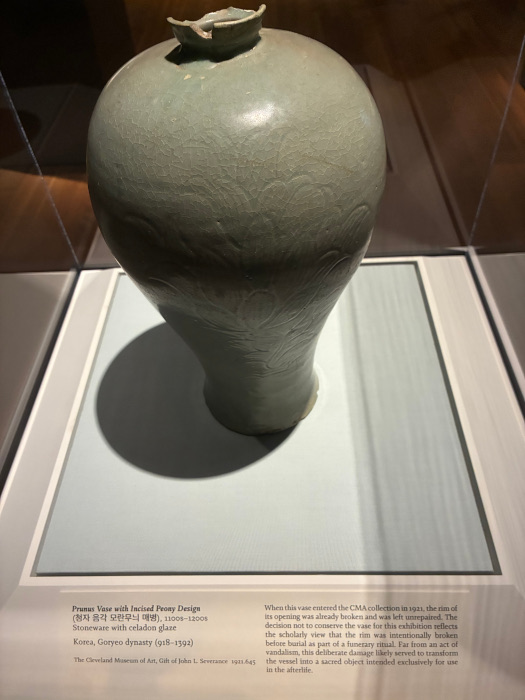
I really liked the idea that the Prunus Vase was purposely broken so it would only be used in the afterlife. Details about the piece are also provided on the Museum's website at: ClevelandArt.org/art/1921.645
In one of the exhibition's galleries, visitors can interact with a three-dimensional model of a Sutra Container 금동 동자유희무늬 불경상자 [金銅童子遊戱文佛經匣]. It can also can be viewed on the museum's website or you can use it any way you like, as I have done here, through the CMA's Open Access Initiative.
Here is the description I saw in the gallery of how the three-dimensional model was created:
Here are my photos and videos from when I explored the Ten Kings of Hell exhibition.
I recommend viewing videos in full screen mode.
Please feel free to pause the video to look more closely at the artwork and to read the interesting facts that are in the slides!!
You might have noticed in my photos above that Spectacular Freedom: Andrew Wyeth and the Modern American Watercolor is the other exhibition that is currently on display at the Cleveland Museum of Art. (Please learn more by clicking here to read my blog post.) I want to repeat here what I wrote in my previous blog post about the Cleveland Museum of Art's combined ticket price discount for its current two exhibitions:
Soprano Minkyeong Kim
As the date of the preview grew closer, invitees received an exciting email update. We would be hearing a performance by local soprano, Minkyeong Kim. She would be opening the Cleveland Museum of Art Ten Kings of Hell preview with her special vocal performance of classical Korean arrangements and Golden from the critically acclaimed KPop Demon Hunters.
While I was writing this blog post, I learned that her singing at the preview had a deeper meaning for Minkyeong Kim. I saw that she wrote the following on social media about her experience:
Years ago, when I was studying at CIM [Cleveland Institute of Music], I often visited the Cleveland Museum of Art, just across the street, quietly dreaming that one day I might have the opportunity to perform there.
That dream has now come true in the most meaningful way.
I was deeply honored to perform two Korean songs at the media preview of Ten Kings of Hell, a remarkable exhibition curated by Dr. Sooa Im McCormick, the CMA’s Korean art curator. Bringing together all ten paintings from the Goryeo Dynasty for the first time, this groundbreaking exhibition is a significant celebration of Korean art and heritage.
Standing before these extraordinary works of art and singing Korean songs was more than a performance. As a Korean American who still calls Cleveland home, it was a deeply personal moment—a connection between my cultural roots, my musical journey, and the community that has been part of my life for so many years.
Having performed on many stages throughout my musical journey, this experience felt truly unique. It reminded me that music can be more than sound; it can be a bridge between cultures, history, and identity.
My heartfelt thanks to Dr. Sooa Im McCormick for this special invitation, and to Jacqueline on the CMA marketing team for her kindness and professionalism.
If you’re in Cleveland, I wholeheartedly encourage you to visit Ten Kings of Hell at the Cleveland Museum of Art. It is a rare and extraordinary opportunity to experience the beauty and depth of Korean art and history.
Some dreams take years to come full circle. I’m so grateful to have been part of this beautiful moment.
I recommend viewing videos in full screen mode.
Above is my video of part of her performance. It you want to watch the full performance, you are in luck!Soprano Minkyeong Kim posted the full songs on her YouTube channel: https://www.youtube.com/@minkimjoy
Curator Tour with Sooa Im McCormick
Korea Foundation Curator of Korean Art
After a welcome message and exhibition background information from Cleveland Museum of Art Chief Marketing Officer Todd Mesek, preview attendees heard details about the exhibition during a guided tour with Cleveland Museum of Art's Curator of Korean Art, Sooa Im McCormick.
It was especially interesting and helpful to hear the curator's talk, and her description of the layout and progression of the exhibition, from burial artifacts, to hell, and then to paradise. I strongly recommend taking a curator- or docent-guided tour of the exhibition. Here is part of the official exhibition press release that mentions the sections of the exhibition:
I recommend viewing videos in full screen mode.
Please feel free to pause the video to look more closely at the artwork.
Yale University Press Book: Ten Kings of Hell - The Afterlife in Medieval Korea
If you click on the "BOOK FLYER" button on the Yale University Press web page, you will see: "Use code YUP25 at checkout for 25% off. Valid in the United States and Canada. Print editions only."
Related Blog Posts
I always like to include in our blog posts a list of related posts that may be of interest to our readers, but since there are so many Cleveland Museum of Art blog posts, I will just list the three blog posts which include Curator Sooa Im McCormick, followed by related blog post categories:
Blog Date: May 2, 2024 - Fine Print Fair, Korean Couture, Seven Jeweled Mountain: Variety at The Cleveland Museum of Art
See the following sections of this blog post for the exhibitions where Korea Foundation Curator of Korean Art, Sooa Im McCormick, was involved:
- Korean Couture: Generations of Revolution Preview
- Into the Seven Jeweled Mountain: An Immersive ExperienceBlog Date: April 27, 2021 - Return Visit to Stories from Storage - From the Cleveland Museum of Art, with Love
Blog Date: February 28, 2021 - From the Cleveland Museum of Art, with Love - Stories from Storage
"Asian Culture" - Five past blog posts.
"Art" - 109 past blog posts.
"Cleveland Museum of Art" - 68 past blog posts.
"University Circle" - 88 past blog posts.
"Summit Artspace" - Seven past blog posts.
Thank you for reading my blog post! I was very grateful to be able to attend the preview and curator tour of Ten Kings of Hell: The Afterlife in Medieval Korea, and the many other exhibitions I have seen over the years at the Cleveland Museum of Art! I hope this blog post encourages you to attend future events at the Cleveland Museum of Art.
You can learn about my wife and co-blogger, Julie's, and my travel journeys and the venues we explore in Cleveland and Akron at: sosAssociates.com/Blog
Disclosure: I received an invitation to attend the Wednesday, October 7, 2026, Media & Influencer Preview of Ten Kings of Hell: The Afterlife in Medieval Korea, which included refreshments, a commemorative pin from the exhibition, admission to the exhibition, and a tour led by Korea Foundation Curator of Korean Art Sooa Im McCormick. Since my wife and co-blogger, Julie, and I are members of the Cleveland Museum of Art, we were already entitled to free tickets to Ten Kings of Hell: The Afterlife in Medieval Korea, and I now plan to return to see the exhibition again with Julie.
The invitation to attend came as a result of my support of the Cleveland Museum of Art with my many sosAssociates.com blog posts about the museum. I greatly enjoyed the event, and wrote this blog post to share my experience at Ten Kings of Hell: The Afterlife in Medieval Korea, at the Cleveland Museum of Art.